
Mapping Qatar's Digital Horizon
As part of the National Vision 2030, Qatar has rapidly accelerated its telecommunications infrastructure to become a global leader in connectivity. The rollout of 5G is not just about speed; it is the backbone of a smart economy, enabling everything from autonomous transport to advanced industrial IoT.
Signal Strength Across The Peninsula
Interact with the map below to explore simulated coverage hotspots. Hover over the pulsing zones to reveal detailed latency and density metrics for specific districts.
Signal Legend
The Capital's Connectivity Core
Doha serves as the nerve center of the national network. The density of infrastructure here supports millions of simultaneous connections, powering the daily operations of business, government, and leisure.
West Bay
The financial district demands zero-latency for high-frequency trading and corporate VPNs.
- Avg Speed 920 Mbps
- Stability 99.9%
The Pearl
Residential luxury requires consistent throughput for smart home ecosystems and streaming.
- Avg Speed 880 Mbps
- Indoor Excellent
Msheireb
Downtown heritage sites utilize underground fiber to maintain visual integrity while staying connected.
- Avg Speed 750 Mbps
- Tech Sub-6 GHz
Hamad Int'l Airport
One of the busiest travel hubs in the region, equipped with massive capacity for passenger roaming.
- Avg Speed 1.1 Gbps
- Load Variable
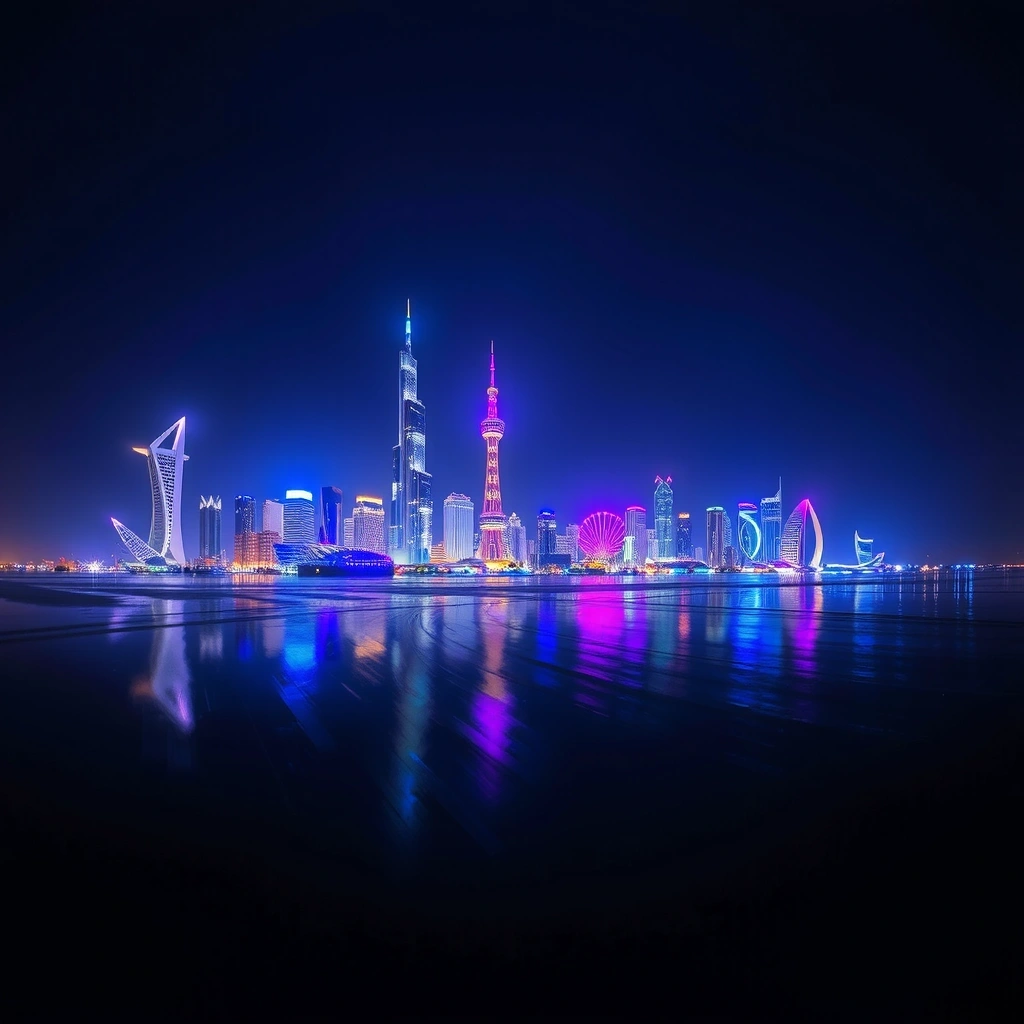
Lusail: The Smart City Standard
Designed from the ground up for the digital age, Lusail represents the pinnacle of 5G integration. The city's infrastructure treats connectivity as a utility, essential for its autonomous transport grids and smart energy grids.
From the Energy City towers to the waterfront promenades, the network architecture utilizes high-band spectrum to support millions of IoT sensors. This allows for real-time traffic management, automated waste collection, and smart street lighting that adapts to pedestrian movement.
Autonomous Zones
Dedicated low-latency lanes for autonomous delivery vehicles.
Stadium Coverage
Massive MIMO tech handles peak density during major events.
Expanding Beyond Doha's Borders
While the capital offers the highest density, the network reach extends efficiently to support the growing residential and industrial needs of the outer municipalities.
Al Rayyan
Home to the Education City and vast residential districts, Al Rayyan relies on a robust backbone to support university research and suburban connectivity. The coverage here is optimized for consistent throughput rather than peak raw speed.
-
Education City High-speed blanket for international student hubs and research labs.
-
Sports Stadiums Temporary capacity boosting deployed during match days.
-
Al Luqta & Gharrafat Expanded residential towers now fully connected with 5G indoor units.
Al Wakrah
Balancing rapid residential growth with industrial port activity, Al Wakrah's network is designed for versatility. It supports the high bandwidth needs of the Hamad Port logistics sector alongside consumer demand in the Souq area.
-
Al Janoub Stadium Area Permanent high-density infrastructure to serve spectators year-round.
-
Hamad Port Private 5G networks facilitate automated crane and logistics operations.
-
Mesaieed Industrial Low-band 5G ensures wide-area coverage for remote monitoring sensors.
Visualizing the Network Pulse
Ultra High Speed Zones
Defined by average download speeds exceeding 1 Gbps. Typically found in dense urban centers with mmWave or high-band Mid-band implementation. These areas offer the lowest latency, often below 10ms.
Standard 5G Coverage
Represents speeds between 300 Mbps and 1 Gbps using Sub-6 GHz frequencies. This offers the best balance of range and speed, forming the broad blanket of coverage across residential and suburban areas.
Tower Density & Load
"Tower Density" indicates the proximity of cell sites, which correlates with signal consistency. "Load" represents current network congestion; during high load, speeds may throttle slightly but latency remains stable on 5G standalone networks.
The Next Phase of Expansion
Q4 2024: Northern Reach
Infrastructure upgrades scheduled to complete the ring-road coverage for Al Khor and the northern beaches. This phase focuses on improving reliability for the growing communities in the north.
2025: 5G Advanced (5.5G)
Trials for the next evolution of wireless technology begin in Lusail. 5.5G aims to deliver downlink speeds of 10 Gbps and integrate AI into network management to predict and fix congestion before users notice it.
National Vision 2030 Goals
Achieving 99% population coverage with a minimum of 100 Mbps average throughput. The focus shifts from "coverage" to "smart integration," linking the network to water, power, and transport grids nationwide.